


Garry Kasparov is the chairman of the Renew Democracy Initiative, which publishes The Next Move.
Donald Trump is pining for 1776 again.
Trump’s nostalgia is not the patriotic “spirit of ‘76,” nor even the whitewashed version of US history presented in his first term’s “1776 Commission.” In fact, it has nothing to do with America’s 250th anniversary.
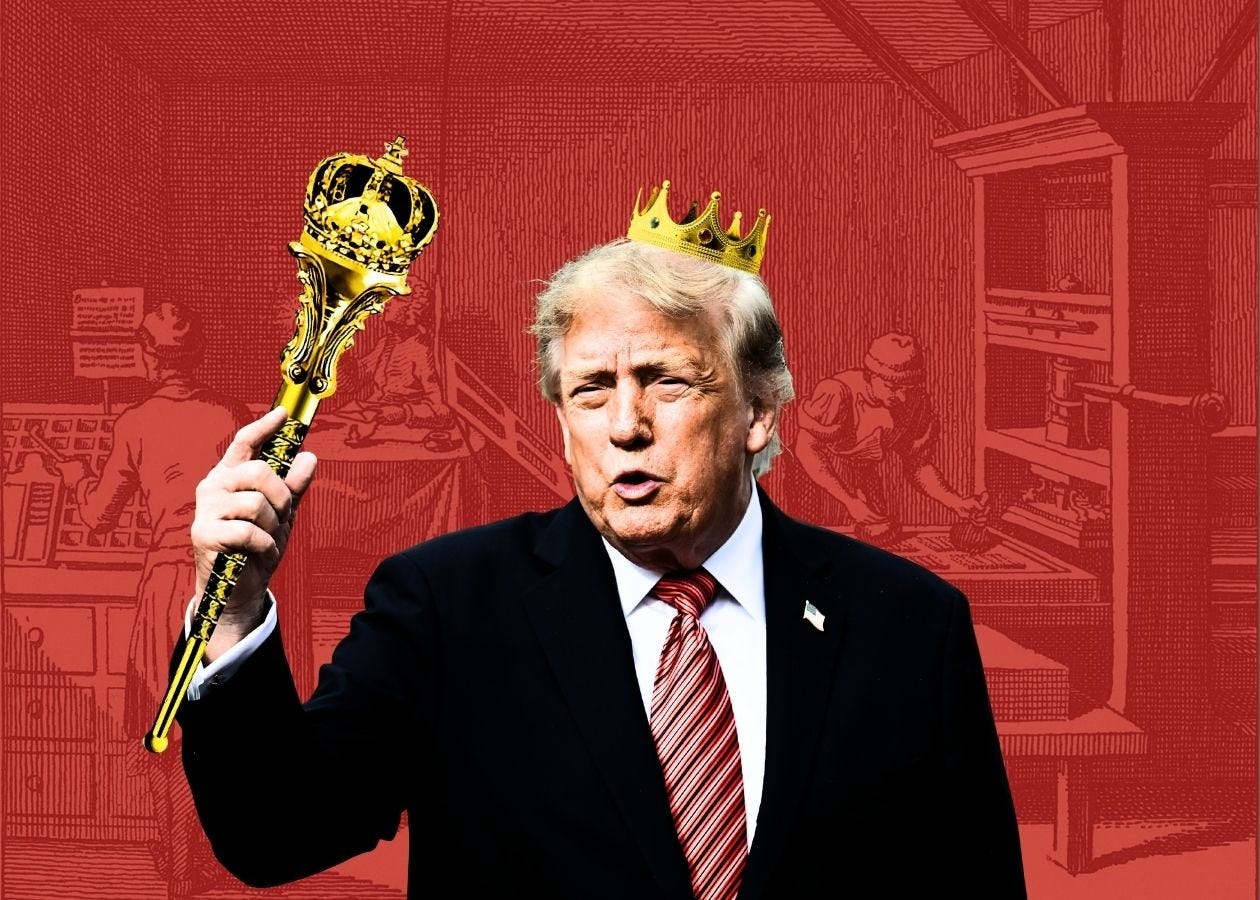
The president simply wants to reign like an eighteenth-century king.
Last Friday afternoon, I was recording a segment with Jake Tapper on CNN about my last column on The Next Move. I found myself waiting a while at the network’s studios; the news cycle had been overtaken by Trump’s decision to ban CNN and two other media platforms (MS NOW and Politico) from the White House grounds.
The affected outlets’ offense, in Trump’s words, was “their constant ‘reporting’ FAKE NEWS!”
Would King George III be proud? In 1776, agents of the Crown could raid a newspaper’s offices for publishing critical commentary about the royal regime. The Stamp Act was imposed to smother America’s nascent free press in the cradle. Authorities in London charged publishers sympathetic to the rebels under Britain’s seditious libel laws.
Perhaps the jilted King George can find some relief from beyond the grave. Two and a half centuries after the American Revolution, the colonists—one colonist in particular—are finally coming home to the monarchical tradition.
Of course, not everyone understands King Trump’s wisdom in banning those upstart “fake-news” outlets. Let me amend that statement—evidently, no one understands. Not even Trump-friendly Fox and Trump-curious CBS are defending his press ban. Oh well; it was ever thus. They called George III “mad” too.
Will anyone challenge King Trump’s royal prerogative? Only if his opponents do not aspire to kingship themselves. The powers of the American president have long been described as “imperial”; members of both parties swept away concerns about this. They always assumed that the next king would be a good one.
ICYMI: Tune in to the latest episode of the Older/Wiser Podcast

A Democratic presidential nominee could mobilize significant appeal among the masses if they were to run on a platform of limiting executive power.
They could return much of the spending, war-making, and diplomatic authority that have slid from Congress to the White House over the decades. They might commit to not rule by decree—or, if you prefer the American euphemism, “executive order.”
Maybe a future president would even support codifying that presidential communications must run through official channels: no monarchical musings on Truth Social or X.
King George would say that voluntarily ceding power cuts against human nature. When another George, Washington, was set to resign his military command and retire a victorious civilian, the king exclaimed disbelievingly that “if [Washington] does that, he will be the greatest man in the world.”
This takes me to the central question Americans confront in the person of their elected king. With a president playing the George III of 1776, can any American leader emulate his opposites, the men and women who defeated the Crown, those whom the king himself begrudgingly named “the greatest…in the world”?
More from The Next Move:
I Saw How Russia Killed Media Freedom

Censorship is central to the story of Russia’s descent into KGB dictatorship.
What to This Russian Is the Fourth of July?

The America of my Soviet upbringing was both distant and extremely close.
I see signs from the local GOP telling me to "Vote Like it's 1776". I couldn't understand what they meant until I remembered that there was no election in 1776.
No kings in the U.S. period. End of story.